
July 2026 Market Recap
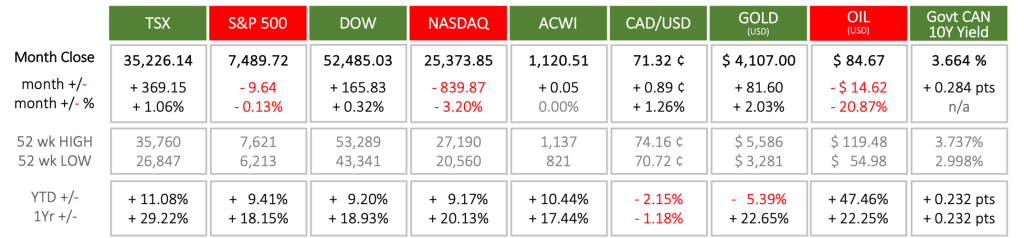
Last Month in the Markets: July 1 – 31, 2026
What Happened in July?
As many anticipated, the conflict between the United States and Iran continued to dominate political and economic headlines throughout July and remained a significant influence on global financial markets.
On July 8, President Trump declared the ceasefire over following renewed military attacks, including drone and missile strikes, between the two countries. Iran launched attacks against U.S. interests throughout the region, prompting the United States to respond with strikes on nearly 150 targets.
On July 14, the blockade of Iranian ports was reinstated, and President Trump threatened to impose fees on ships transiting the Strait of Hormuz. Further escalation occurred on July 17 and 18, when four U.S. service members were killed. By July 26, the Pentagon had updated its casualty figures, reporting 18 fatalities and 624 wounded personnel.
The conflict continued to have a significant impact on global oil markets. Following a brief period of diplomatic progress, renewed military escalation beginning on July 7 drove oil prices higher, with prices peaking on July 23. Although prices moderated toward the end of the month, crude oil remained more than 20% above its February level, before the bombing of Iran began six months earlier.
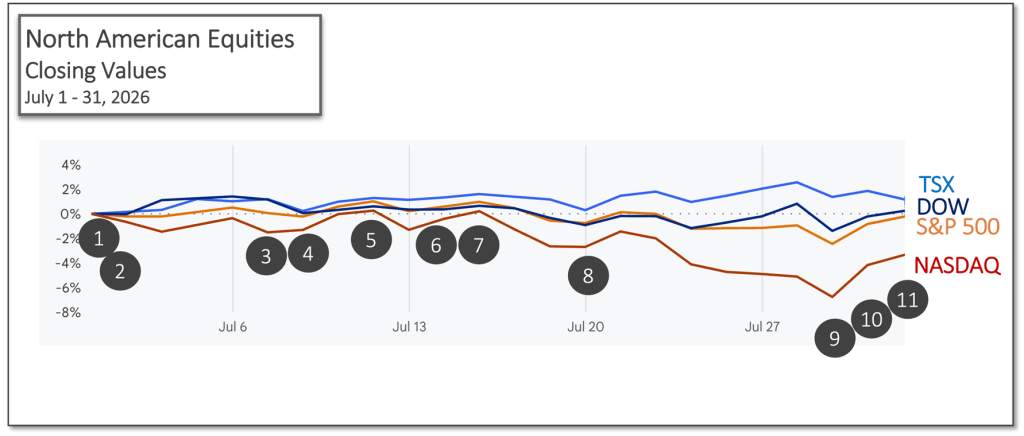
Events that influenced markets in July included:
1. June 30 – Canadian Economic Growth Carried Momentum into July
Canada’s real Gross Domestic Product (GDP) grew 0.5% in April after contracting 0.1% in March. Growth was supported by both goods-producing industries (+1.2%) and service-producing industries (+0.3%).
The strongest contributors included mining, quarrying, oil and gas extraction, the public sector, and transportation and warehousing.
2. July 2 – U.S. Employment Grew Modestly
According to the U.S. Employment Situation Summary, nonfarm payroll employment increased by 57,000 in June.
Most of the job growth occurred in professional and business services (+36,000), social assistance (+25,000), and healthcare (+22,000).
3. July 7 – Canada’s Trade Surplus Expanded While the U.S. Trade Deficit Widened
Canada’s merchandise trade surplus increased to $4.2 billion in May from $3.4 billion in April as export growth outpaced imports. This marked Canada’s third consecutive monthly trade surplus.
In contrast, the U.S. trade deficit widened significantly to $77.6 billion in May, up from $54.6 billion in April—a 42% increase. The larger deficit reflected a 3.2% decline in exports alongside a 3.3% increase in imports.
4. July 8 – U.S.–Iran Ceasefire Ended
Following ongoing disputes over negotiations and multiple rounds of military attacks, President Trump formally declared the ceasefire with Iran had ended.
Despite the renewed hostilities, diplomatic communications between the two countries reportedly continued.
5. July 10 – Canadian Employment and Unemployment Improved Slightly
Statistics Canada’s Labour Force Survey showed employment increased by 18,000 in June, while the unemployment rate declined by 0.1 percentage points to 6.5%.
Employment gains were concentrated among youth and core-aged workers, while employment among older Canadians declined.
6. July 14 – U.S. Inflation Slowed but Remained Above Target
U.S. inflation eased in June compared with May. The Consumer Price Index (CPI) declined 0.4% month over month after increasing 0.5% in May.
On a year-over-year basis, inflation slowed to 3.5%, down from 4.2% in May. Much of the improvement resulted from falling energy prices, with the energy index declining 5.7% in June after increasing 3.9% in May, 3.8% in April, and 10.9% in March.
Core inflation, which excludes food and energy, remained unchanged at 2.6% year over year.
7. July 15 – Bank of Canada Held Interest Rates Steady and Released Its Monetary Policy Report
The Bank of Canada maintained its overnight rate at 2.25%, the Bank Rate at 2.50%, and the deposit rate at 2.20%.
These rates have remained unchanged since October 29, 2025, following six consecutive policy decisions.
In its announcement, the Bank cited higher oil prices, slowing global GDP growth, uneven Canadian economic growth, resilient global equity markets, higher U.S. bond yields, solid consumer spending, and elevated inflation as key factors influencing its decision.
The Bank also released its latest Monetary Policy Report, noting that Canada’s trade relationship with the United States and the ongoing conflict in the Middle East remain the two greatest risks to the inflation outlook.
8. July 20 – Canadian Inflation Slowed
Canada’s Consumer Price Index increased 2.8% year over year in June, down from 3.2% in May.
Excluding gasoline, inflation remained unchanged at 2.2%, indicating that energy prices continued to account for much of the headline inflation reading.
9. July 29 – Federal Reserve Left Interest Rates Unchanged
The Federal Reserve maintained the federal funds rate within a target range of 3.50% to 3.75%.
Although employment remained strong and unemployment low, three of the twelve Federal Open Market Committee members voted in favour of an interest rate increase due to ongoing inflation concerns.
10. July 30 – U.S. Inflation Remained Elevated While Economic Growth Slowed
The Federal Reserve’s preferred inflation measure, the Personal Consumption Expenditures (PCE) Price Index, increased 3.7% compared with June 2025.
Core PCE, which excludes food and energy, rose 3.3%. Both headline and core inflation remained well above the Federal Reserve’s 2% target.
Meanwhile, U.S. Gross Domestic Product (GDP) expanded at an annualized rate of 1.5% during the second quarter, representing slower growth than in the first quarter of 2026.
11. July 31 – Canadian GDP Rebounded for a Second Consecutive Month
Canada’s GDP increased 0.3% in May, marking a second consecutive month of economic growth as both goods-producing and service-producing industries expanded.
Growth continued to be led by mining, quarrying, and oil and gas extraction. Additional contributions came from government services, construction, real estate, rental and leasing, manufacturing, finance and insurance, and transportation and warehousing.
What’s Ahead for August and Beyond?
Until the conflict in the Middle East subsides and a lasting peace is established, market uncertainty and volatility are likely to persist.
Over time, sustained higher oil prices could become embedded in the global economy, affecting corporate profitability, economic growth, and longer-term inflation. Should inflation remain elevated through the fall and winter, both the Bank of Canada and the U.S. Federal Reserve may need to reconsider their current interest rate outlooks. Market expectations have increasingly shifted toward the possibility of additional rate hikes by the Federal Reserve.