
June 2025 Market Recap
Last Month in the Markets: June 2025
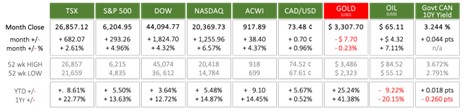
| What happened in the first half of 2025 The turmoil and steep decline in April caused by Trump’s global trade war now feels like a distant memory following a solid recovery. Overall, the TSX is leading North American equity indexes, with a gain of over 8.5% so far this year.  What happened in June? The month began positively for equity investors. However, the first half of June was marked by volatility due to mixed economic signals. On June 12, Israel launched an attack on Iran, creating uncertainty and contributing to a gradual market decline. That said, the final week of trading delivered most of the month’s gains for U.S. indexes. The TSX followed a similar trajectory, albeit more steadily, finishing the month with a gain of 2.5%.  Key Economic and Geopolitical Events Influencing June Markets: 1. May 29–30 – Mixed Canadian employment and GDP data Canadian payroll employment fell by 54,000 in March after declining by 40,200 in February. However, GDP grew by 0.5% in Q1 2025, matching Q4 2024’s pace. The increase was driven by higher exports of passenger vehicles (+16.7%) and industrial machinery (+12.0%), likely in anticipation of potential U.S. tariffs. 2. June 4 – Bank of Canada held interest rates steady The Bank of Canada kept its overnight rate unchanged at 2.75% for the second consecutive decision. The Bank cited continued uncertainty around U.S. tariffs, a softening (but not weakening) Canadian economy, and unexpected firmness in inflation as reasons for maintaining the rate. 3. June 5 – European Central Bank lowered interest rates In contrast to the Bank of Canada, the European Central Bank reduced its interest rate by 0.25% as inflation remained near the 2% medium-term target. 4. June 6 – Canadian and U.S. job reports signaled slowing employment In the U.S., nonfarm payrolls rose by 139,000 in May, while the unemployment rate held steady at 4.2%. This was slightly below the 12-month average of 149,000 new jobs per month. In Canada, employment in May was virtually unchanged (+8,800), the employment rate remained at 60.8%, and the unemployment rate edged up to 7.0%. Since January, employment growth in Canada has been flat. 5. June 12 – Rising tensions in the Middle East impacted markets Israel attacked Iranian nuclear sites and military infrastructure, prompting a retaliatory response. The news triggered a broad selloff in equities, except for energy stocks, as oil and gold prices spiked. 6. June 18 – Federal Reserve maintained its wait-and-see approach The U.S. Federal Reserve held interest rates steady, citing improved but still uncertain economic conditions. The target range for the federal funds rate remained at 4.25% to 4.5%. 7. June 22 – U.S. launched airstrikes in Iran President Trump ordered a bombing raid on three Iranian sites targeting nuclear facilities. Oil prices rose roughly 10% in response. Any disruption in Iranian oil exports could negatively affect China and further strain U.S.-China relations. Two days later, President Trump announced a ceasefire between Israel and Iran. 8. June 24 – Canadian inflation remained below the Bank of Canada’s target The Consumer Price Index (CPI) rose 1.7% year-over-year in May, unchanged from April. On a monthly basis, it increased 0.6%. Lower rent increases and falling travel tour prices helped keep inflation subdued. Excluding energy, core CPI rose 2.7% in May versus 2.9% in April. 9. June 26–27 – U.S. and Canadian GDP declined U.S. GDP fell at an annualized rate of 0.5% in Q1 2025, compared to a 2.4% gain in Q4 2024 before the trade war began. Canada’s GDP edged down by 0.1% in April after a 0.2% rise in March. Goods-producing industries contracted by 0.6%, largely due to a drop in manufacturing. Service-producing industries grew slightly, by 0.1%. 10. June 27 – U.S. inflation slightly exceeded Fed’s target In May, personal income fell by $109.6 billion and disposable income dropped by $125 billion. The Personal Consumption Expenditures (PCE) price index rose 2.3% year-over-year. Excluding food and energy, core PCE increased 2.7%. 11. June 27–30 – Canada-U.S. tariff negotiations stalled and resumed President Trump suspended trade and tariff negotiations with Canada in retaliation for Canada’s Digital Services Tax. The tax was withdrawn on June 30, reopening trade talks. What’s Ahead for July and Beyond? July 21 marks the next key deadline for Canada-U.S. tariff negotiations. Trade developments, along with inflation, employment data, and interest rate decisions, will shape market direction for the second half of 2025.Geopolitical tensions, particularly in the Middle East, remain a key source of uncertainty. While Iran’s initial response has been mild, the situation could escalate and increase market volatility.Finally, slowing GDP growth and stalled employment could prompt interest rate cuts by both the Bank of Canada and the U.S. Federal Reserve during their meetings on July 30. Any such moves would likely be viewed positively by equity markets. |