The Summer of Space: Why Investors Should Think Twice Before Chasing the Latest Mania
The following article reflects the personal opinions of the author and is intended for educational purposes only. It should not be considered investment advice or a recommendation regarding any security.
Every few years, the market finds a new story.
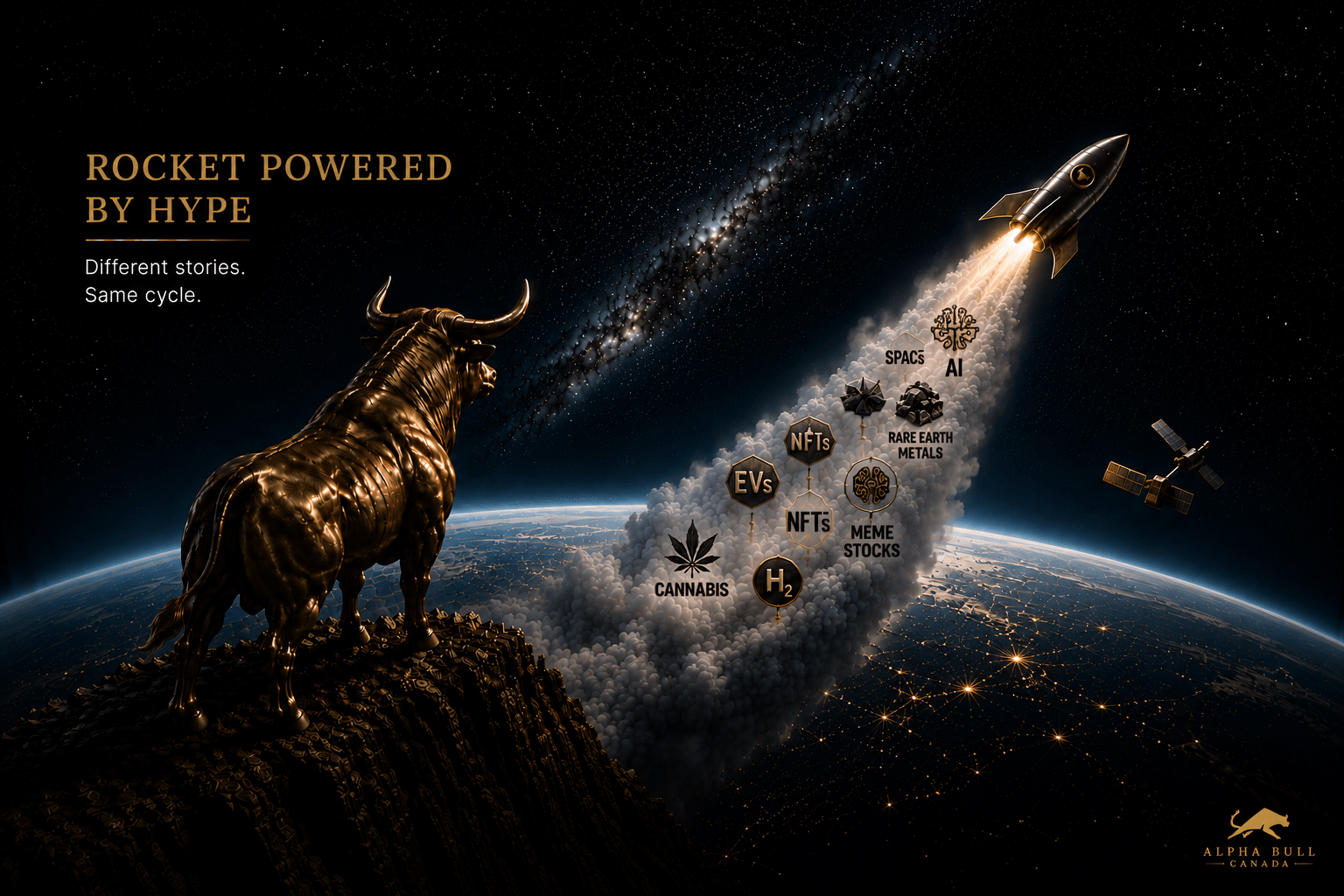
In 2018 it was cannabis.
In 2020 it was electric vehicles, SPACs, and work-from-home stocks.
Then came NFTs, meme stocks, rare earth metals, hydrogen, AI, and quantum computing.
Now, it appears we’re entering what some are calling the “Summer of Space.”
Rocket companies, satellite businesses, space tourism firms, and anything remotely connected to orbit are attracting tremendous investor attention. Stock prices are climbing, valuations are expanding, and social media is filled with predictions of life-changing gains.
Perhaps some of those predictions will prove correct.
But history suggests investors should proceed with caution.
Every Bubble Has a New Story
One of the most dangerous phrases in investing is:
“This time is different.”
The technology changes.
The narrative changes.
The headlines change.
Human nature does not.
Speculative manias tend to share common characteristics:
- Exciting stories
- Massive addressable markets
- Fear of missing out
- Easy access to capital
- Investors willing to overlook risk
Space investing checks many of those boxes.
The idea of owning the next great launch company, satellite network, or space infrastructure provider is undeniably appealing.
The challenge is that a great story does not automatically translate into a great investment.
Building a Real Space Business Is Exceptionally Difficult
Few industries are as technically demanding and capital intensive as aerospace.
Launching payloads into orbit requires:
- Highly specialized engineering talent
- Significant research and development
- Advanced manufacturing capabilities
- Extensive testing
- Regulatory approvals
- Large amounts of capital
This is one reason why relatively few companies have successfully developed launch capabilities at scale.
Investors evaluating space-related opportunities should ask important questions:
- Does the company possess unique technology?
- Is there evidence of meaningful progress toward commercialization?
- How much capital will be required to reach profitability?
- Does management have a realistic path to execution?
These questions are often far more important than the excitement surrounding the sector itself.
Speculation Often Attracts Promotion
One recurring feature of speculative markets is the emergence of companies that receive significant investor attention long before their underlying businesses are proven.
This does not mean such companies will fail.
Some may ultimately become highly successful.
However, history suggests investors should be cautious when valuation growth significantly outpaces business development.
During previous speculative cycles—including cannabis, SPACs, and other emerging sectors—many companies were rewarded with enormous valuations based primarily on future expectations rather than demonstrated financial results.
Space investing may be experiencing a similar dynamic today.
The existence of a large potential market does not guarantee a profitable business model.
The AST SpaceMobile Debate
One company that has captured significant investor attention is AST SpaceMobile.
The company’s vision is ambitious and compelling: providing direct satellite connectivity to ordinary mobile phones around the world.
If successful, the potential opportunity could be substantial.
However, investors should remember that promising technology and attractive investment returns are not always the same thing.
The company continues to face significant execution, capital, competitive, and commercialization challenges.
Even if the technology ultimately succeeds, investors must still determine whether current valuations adequately reflect those risks.
History contains countless examples of companies with excellent products that nevertheless produced disappointing shareholder returns because expectations became unrealistic.
Investors should be careful not to confuse potential with certainty.
Why Early Investors Often Benefit the Most
One lesson repeated throughout market history is that the greatest gains are often realized by founders, venture capital firms, and early-stage investors.
By the time a company reaches public markets—or becomes widely discussed among retail investors—much of the initial value creation may already have occurred.
This does not mean public investors cannot earn attractive returns.
However, it does mean investors should be mindful of the price they are paying relative to the risks they are assuming.
When enthusiasm becomes widespread, valuations can sometimes detach from fundamentals.
That is rarely a recipe for long-term investment success.
The Virgin Galactic Lesson
Consider Virgin Galactic.
The company has achieved something genuinely impressive by creating a functioning commercial space tourism business.
Yet despite its technological accomplishments and public profile, profitability remains a challenge.
This illustrates an important investing lesson:
A company can have real technology, real customers, and real products while still struggling to generate attractive economic returns.
Nonetheless, I would not be surprised to see renewed investor enthusiasm for companies like Virgin Galactic during the current wave of interest in space-related investments.
History shows that many investors are drawn to exciting narratives, often placing less emphasis on valuation, cash flow, and profitability than they should.
Eventually, however, fundamentals tend to matter.
Missing Out Is Not the Worst Outcome
As advisors, we frequently hear questions like:
“What if this becomes the next Tesla?”
That is a fair question.
But investors should also ask:
“What if it doesn’t?”
Many sectors that generated extraordinary excitement ultimately delivered disappointing returns for those who arrived late.
Cannabis.
SPACs.
Hydrogen.
Rare earth metals.
Countless technology booms throughout history.
Not every promising theme becomes a profitable investment.
Personally, I am comfortable missing opportunities that require near-perfect execution and near-perfect timing.
I would rather miss part of an upside move than expose capital to a permanent loss of capital.
Investing should be about managing risk as much as pursuing returns.
There Is No Get-Rich-Quick Strategy
The reality that many investors dislike hearing is also the reality that has built the most wealth over time.
There is no reliable get-rich-quick strategy.
There never has been.
Long-term wealth creation typically comes from:
- Owning productive businesses
- Diversification
- Patience
- Compounding
- Risk management
- Maintaining discipline when others become emotional
These principles may not be exciting, but they have stood the test of time.
The current enthusiasm surrounding space investing may ultimately produce several successful companies.
Some investors may earn exceptional returns.
And I could certainly be wrong in my skepticism.
However, if avoiding a speculative opportunity means potentially missing some upside while reducing the risk of a significant capital loss, that is a trade-off I am comfortable making.
Sometimes the best investment decisions are not about identifying the next rocket ship.
They are about avoiding investments that rely on hope, hype, and perfect outcomes to justify their valuation.
In investing, preserving capital is often more important than chasing the next big thing.