
September 2026 Market Recap
Last Month in the Markets: September 1 – 30, 2026
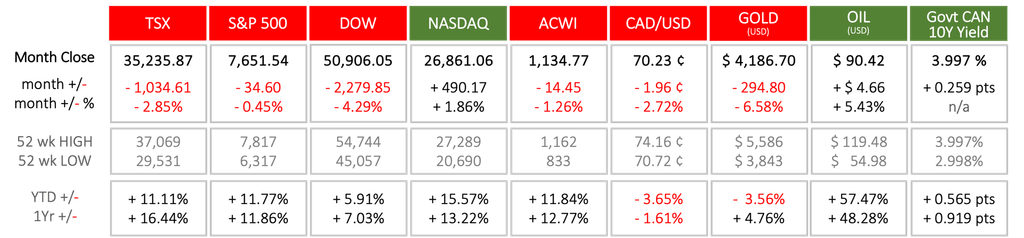
Last Quarter in the Markets: July 1 – September 30, 2026

What Happened in September ?
September was a disappointing month for equity investors with significant exposure to North American markets. However, when viewed over the broader third quarter, investment returns were more favourable.
The primary factors influencing markets throughout September and the third quarter remained largely unchanged. Inflation continued to be elevated, prompting both the U.S. Federal Reserve and the European Central Bank (ECB) to increase their benchmark interest rates.
Higher energy prices, particularly for crude oil, gasoline, and diesel fuel, continued to contribute to inflationary pressures. These increases were largely driven by ongoing uncertainty and fluctuations in supply resulting from the conflict between the United States and Iran.
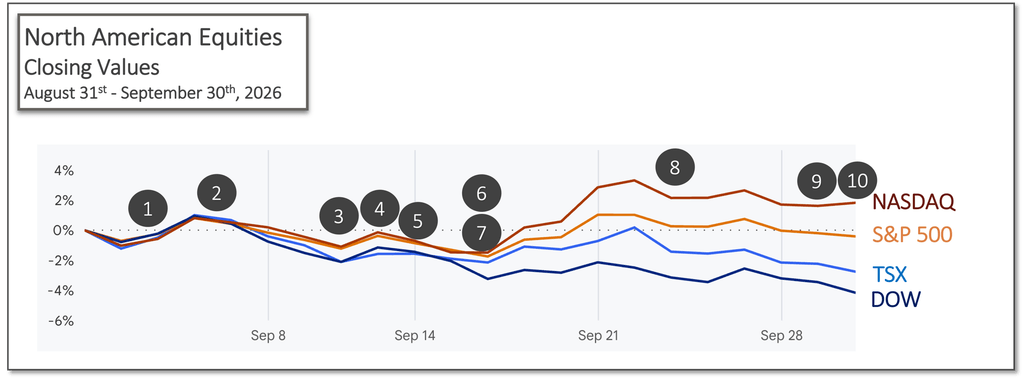
Events that influenced markets included:
1. September 2 – Bank of Canada Held Interest Rates Unchanged
The Bank of Canada maintained its policy interest rate, the overnight rate, at 2.25%.
In its announcement, the Bank highlighted the ongoing conflict in the Middle East and the breakdown of trade and tariff negotiations between Canada and the United States as significant sources of uncertainty. Both situations were described as fluid, reflecting the challenges they present for the Canadian economic outlook.
2. September 4 – Canadian Employment Declined While U.S. Job Growth Strengthened
Canada’s labour market experienced a significant setback in August. According to Statistics Canada’s Labour Force Survey, employment declined by 42,000 jobs, contrary to analysts’ expectations of a modest increase.
Despite the decline in employment, Canada’s unemployment rate remained unchanged at 6.4%.
In contrast, the U.S. labour market delivered stronger-than-expected results. Nonfarm payroll employment increased by 162,000 in August, significantly exceeding economists’ expectations of approximately 53,000 new jobs.
3. September 10 – European Central Bank Raised Interest Rates Amid Inflation Concerns
The European Central Bank increased its benchmark interest rate by 0.25 percentage points, or 25 basis points, in response to persistent inflationary pressures.
The ECB emphasized that the ongoing conflict in the Middle East continued to contribute to rising prices and that inflation was expected to remain above its target for an extended period.
4. September 11 – U.S. Consumer Inflation Increased Again
U.S. consumer inflation accelerated in August, according to the Bureau of Labor Statistics.
The Consumer Price Index (CPI) increased 0.4% during the month, compared with a 0.1% increase in July. Gasoline prices rose nearly 4% in August and accounted for approximately one-third of the monthly increase in consumer prices.
On a year-over-year basis, the CPI increased 3.4%, unchanged from the annual inflation rate reported in July.
5. September 14 – Canadian Inflation Remained at 3%
Canada’s Consumer Price Index increased 3.0% year over year in August, matching the inflation rate recorded in July.
Although gasoline prices increased at a slower pace than in the previous month, higher travel and rental costs offset much of that improvement, keeping overall inflation elevated.
6. September 16 – Federal Reserve Raised Interest Rates to Combat Inflation
The U.S. Federal Reserve increased its benchmark interest rate by 0.25 percentage points, or 25 basis points, marking its first rate increase in three years.
The decision reflected the Federal Reserve’s continued concern about elevated inflation and its commitment to returning inflation to its 2% target.
Alongside the announcement, the Federal Reserve released its updated Summary of Economic Projections, including the closely watched “dot plot,” which illustrates policymakers’ expectations for future interest rates.
The projections indicated that committee members anticipated the possibility of one or two additional interest rate increases before the end of 2026.
7. September 16 – Canada and the European Union Explored a Deeper Economic Relationship
Prime Minister Mark Carney met with European Union representatives to discuss strengthening economic and trade relations between Canada and Europe.
During the discussions, the European Union offered Canada the possibility of its first-ever associate membership arrangement. Although the terms of the proposed relationship have not yet been defined or agreed upon, the discussions represent a potential step toward closer economic cooperation.
The initiative aligns with the Canadian government’s broader objective of diversifying international trade relationships and reducing the country’s reliance on the United States.
8. September 24 – Canadian Retail Sales Declined
Canadian retail sales decreased 0.7% in July to $73.7 billion, following a 1.2% increase in June.
The decline was widespread, with eight of the nine retail subsectors reporting lower sales. General merchandise retailers experienced some of the largest declines.
As consumer spending represents an important component of economic activity, the broad-based slowdown raised concerns about the strength of domestic demand.
9. September 29 – Canadian Economic Growth Stalled
Canada’s real Gross Domestic Product (GDP) remained unchanged in July after increasing 0.4% in June.
Neither goods-producing nor service-producing industries recorded overall growth during the month, reflecting a slowdown in economic activity.
One positive development was the construction sector, which expanded 1.3% in July and recorded its fourth consecutive month of growth.
10. September 30 – U.S. Inflation Remained Well Above Target
The Bureau of Economic Analysis reported that the Personal Consumption Expenditures (PCE) Price Index, the Federal Reserve’s preferred measure of inflation, increased 0.3% in August.
On a year-over-year basis, headline PCE inflation rose 3.4%, while core PCE, which excludes the more volatile food and energy categories, increased 3.0%.
Both measures remained significantly above the Federal Reserve’s 2% inflation target, reinforcing concerns about persistent price pressures and the possibility of further interest rate increases.