
August 2026 Market Recap
Last Month in the Markets: August 3 – 31, 2026
What Happened in August?
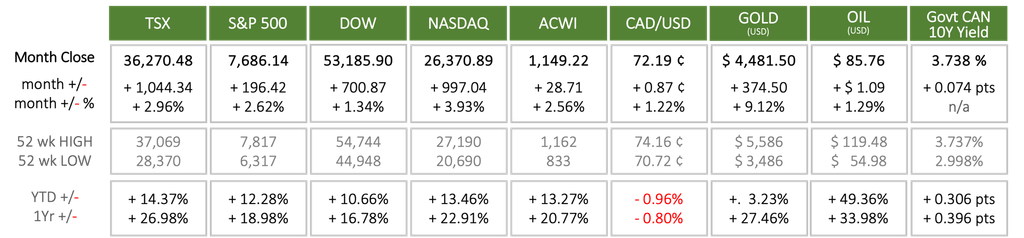
August marked the first month in more than two years in which all major indices in our market overview finished in positive territory. Despite several potential economic headwinds, North American equity markets and the All-Country World Index moved higher.
In Canada, consumer inflation remained above target, but not significantly so, while employment and Gross Domestic Product (GDP) growth continued to demonstrate resilience. The U.S. economy presented a more mixed picture, with inflation remaining well above target and job creation showing signs of weakness.
Both the Bank of Canada and the U.S. Federal Reserve remain focused on their mandates of maintaining price stability and supporting employment. Despite the possibility of rising U.S. interest rates—and the potential impact higher American rates could have on economies around the world—investor enthusiasm for equities remained strong. During August, the TSX and S&P 500 each gained nearly 3%, the Dow Jones Industrial Average rose approximately 1.5%, and the NASDAQ advanced almost 4%.
August concluded with three federal by-elections, all of which resulted in Liberal victories. Initial analysis suggested the results reflected support for Prime Minister Carney’s handling of trade negotiations with the United States. The breakdown of negotiations between Canada and the U.S. dominated domestic headlines during the month and is likely to remain an important issue in the months ahead.
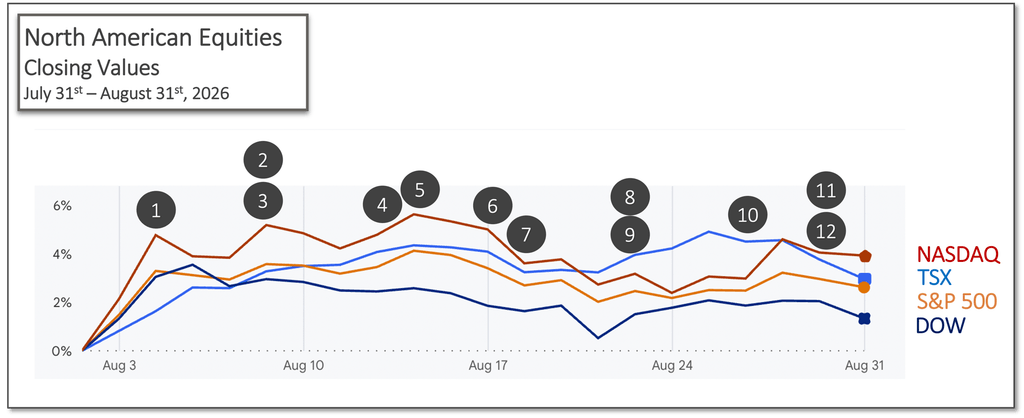
Key Events That Influenced Markets in August:
1. August 4 – Canada’s Trade Surplus Grew Again
Canada’s merchandise trade surplus widened slightly to $3.9 billion in June, up from $3.7 billion in May. Merchandise exports increased 0.4%, outpacing the 0.2% increase in imports.
June marked Canada’s fourth consecutive month with a merchandise trade surplus.
2. August 7 – Canadian Employment Continued to Show Resilience
Canada’s economy added 75,000 jobs in July. Gains were split between full-time and part-time employment, with more than 180,000 jobs added since April.
The unemployment rate declined for the third consecutive month, reaching 6.4%, its lowest level in two years. The figures also reflected a more favourable summer employment environment for students.
3. August 7 – U.S. Employment Weakened
U.S. nonfarm payroll employment declined by 23,000 in July, while the unemployment rate remained relatively stable at 4.1%.
Economists had expected approximately 83,000 jobs to be added during the month. Following downward revisions to previous months, average monthly job growth declined to approximately 34,000, providing further evidence of a slowing U.S. labour market.
4. August 12 – U.S. Consumer Inflation Eased but Remained Above Target
U.S. consumer inflation eased slightly in July, with the Consumer Price Index (CPI) declining by 0.1 percentage points to 3.4% on a year-over-year basis.
On a monthly basis, consumer prices increased 0.1% in July, compared with a 0.4% increase in June. Shelter, food, and food away from home contributed to the increase, while the energy index declined 1.5%.
Although the moderation was encouraging, inflation remained above the Federal Reserve’s 2% target.
5. August 13 – U.S. Wholesale Inflation Eased but Remained Elevated
The U.S. Producer Price Index (PPI) increased 4.7% year over year in July, down from 5.5% in June.
Unlike the Consumer Price Index, which measures prices paid by consumers, the PPI measures changes in prices received by producers. Because changes in production and wholesale costs can eventually be passed along to consumers, the PPI can provide insight into potential future inflationary pressures.
6. August 17 – Canadian Inflation Increased
Canada’s Consumer Price Index increased 3.0% year over year in July, up from 2.8% in June.
Higher gasoline and travel prices, partly driven by increased demand surrounding the World Cup, contributed to the acceleration in inflation. Grocery prices increased 3.1% year over year, remaining slightly above the headline inflation rate.
7. August 18 – Canada–U.S. Trade Talks Were Extended
Approximately 90 minutes before proposed 50% U.S. tariffs on more than $20 billion of Canadian imports were scheduled to take effect, President Trump announced a three-day pause.
Few details were initially provided, but the extension gave negotiators additional time to work toward a broader trade agreement.
8. August 21 – Trade Talks Ended Without an Agreement
Despite the additional negotiating period, Canada and the United States were unable to reach an agreement.
Prime Minister Carney subsequently addressed the outcome from the Canadian perspective, indicating that the U.S. demands were too significant relative to what was being offered in return. The breakdown in negotiations added further uncertainty to the economic and trade outlook between the two countries.
9. August 21 – U.S. Federal Debt Surpassed $40 Trillion
U.S. federal government debt surpassed $40 trillion, marking another significant milestone for the world’s largest economy.
The U.S. recorded a monthly deficit of approximately $432 billion in July 2026, the largest monthly deficit reported since the pandemic. With U.S. federal debt roughly doubling over the past decade, the cost of servicing that debt has also increased substantially.
The federal government’s significant demand for capital may contribute to upward pressure on borrowing costs, while the Federal Reserve continues to balance these conditions against its mandate to control inflation.
10. August 26 – U.S. Inflation Remained Elevated in July
The Federal Reserve’s preferred inflation measure, the Personal Consumption Expenditures (PCE) Price Index, showed consumer prices increasing 3.7% year over year in July, remaining well above the Fed’s 2% inflation target.
Core PCE, which excludes the more volatile food and energy categories, increased 3.3% compared with a year earlier.
The Federal Reserve’s next interest rate decision is scheduled for September 16. Inflation data, together with upcoming employment figures, will be among the most important factors influencing that decision.
11. August 28 – Canada’s Economy Delivered Strong Second-Quarter Growth
Canada’s Gross Domestic Product grew 0.8% during the second quarter of 2026, equivalent to an annualized growth rate of approximately 3.3%.
The increase was supported by a 3.6% rise in exports, led in part by stronger exports of passenger vehicles and light trucks. Auto production had declined during the previous two quarters.
However, with higher U.S. tariffs on Canadian vehicles taking effect, some of the recent increase in production may have reflected manufacturers accelerating activity ahead of the tariff deadline. As a result, the strength in auto production may prove temporary.
12. August 28 – Federal Reserve Chair Signalled Inflation Remains a Priority
Federal Reserve Chair Kevin Warsh used his annual Jackson Hole address to emphasize the importance of bringing inflation under control.
His comments strengthened expectations that the Federal Reserve could raise interest rates sooner rather than later. Following the speech, market expectations shifted further toward the possibility of an upcoming rate increase, rather than rates remaining unchanged.
What’s Ahead for September and Beyond?
In addition to ongoing trade and tariff negotiations, which remained stalled as of August 31, several other issues will be closely watched by investors. These include the ongoing conflict between the United States and Iran, the impact of oil prices on inflation, and the future direction of interest rates.
The Bank of Canada held its policy interest rate unchanged on September 2, as widely expected. The next scheduled interest rate announcement from the U.S. Federal Reserve will take place on September 16. Market expectations currently suggest that the likelihood of U.S. rates remaining unchanged for the rest of 2026 is relatively low. The final two scheduled interest rate decisions of the year for both central banks will occur on October 28 and December 9.
In Canada, future interest rate decisions will be influenced by the effects of the ongoing trade dispute with the United States on domestic inflation and employment. The Bank of Canada may face a difficult balancing act if inflation continues to rise while employment growth stagnates. Higher interest rates can help moderate inflation, while lower borrowing costs generally provide greater support for employment and economic growth.
Central bank policy rates are not the only factor affecting borrowing costs. Bond yields, which generally rise as bond prices fall, have reached levels not seen in approximately two decades. A combination of rising government debt, persistent inflation, and increased borrowing requirements across major economies is placing upward pressure on borrowing costs and creating additional risks for global economic growth.
Finally, escalating conflict in the Middle East pushed oil prices higher toward the end of August and into the beginning of September. Continued uncertainty surrounding both diplomatic and military developments is likely to contribute to volatility across financial markets.