
April 2026 Market Recap
Last Month in the Markets: April 1 – 30, 2026
What happened in April?
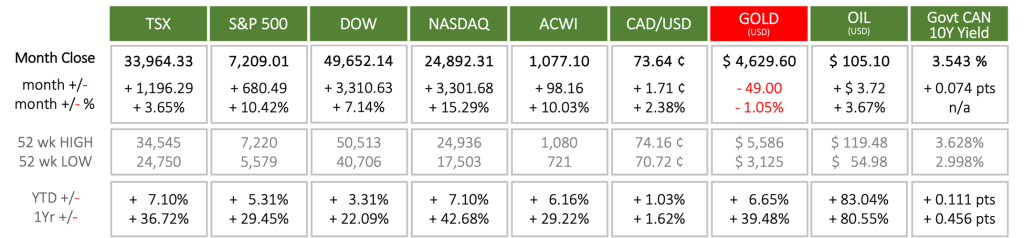
The market results of last month belie the political, humanitarian, and military turmoil occupying most people’s attention. North American equity indexes rose between 3.5% and 15% during April. This performance brought all U.S. indexes back into positive territory for year-to-date performance. The TSX remained in first place for this measure at 7.10% and now shares this position with the NASDAQ. Across these four indexes, the one-year performance ranges from 22% to 42%, representing strong returns despite the events of the past twelve months.
As index values have risen, volatility has thankfully calmed in April, which for some investors can be nearly as important as the prices of underlying equities.
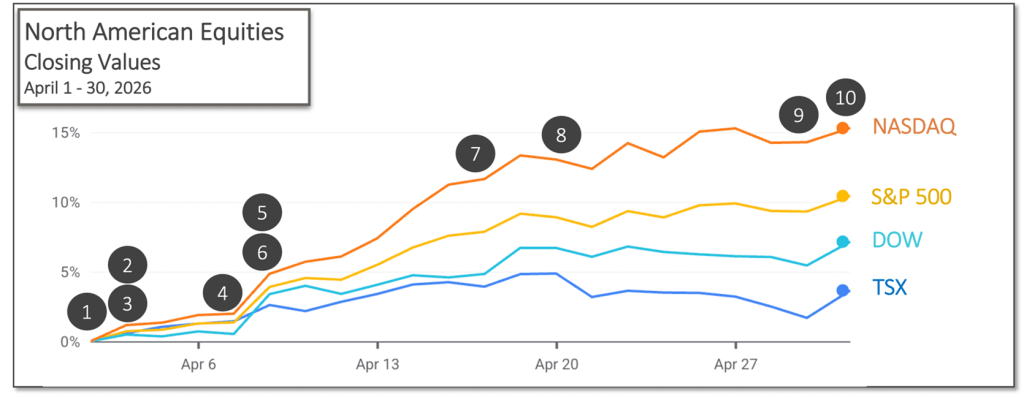
Events that influenced markets in April included:
1. April 1st – Trump spoke and oil jumped again
Trump addressed the nation regarding his war with Iran. West Texas Intermediate, the global benchmark, rose another 14% following his address.
2. April 2nd – Canada’s trade deficit grew overall and shrank with the U.S.
Canada’s merchandise trade deficit widened from $4.2 billion in January to $5.7 billion in February. Canada’s trade surplus with the U.S. narrowed to $1.7 billion in February from $4.9 billion in January.
3. April 2nd – U.S. jobs market reversed February’s losses
The Employment Situation Summary reported that 178,000 jobs were added in March, reversing February’s loss of 133,000 jobs and exceeding analyst expectations. Unemployment changed little at 4.3%.
4. April 9th – American inflation approached its target
The Federal Reserve’s preferred inflation indicator, the Personal Consumption Expenditures (PCE) price index, rose to 2.8% for all items, while Core PCE (excluding food and energy) rose to 3%.
5. April 10th – Canadian jobs reversed previous losses with modest gains
The Canadian economy added 14,000 jobs in March, a significant improvement from February’s loss of 84,000 jobs. The unemployment rate remained unchanged at 6.7%.
6. April 10th – U.S. CPI reflected increased oil and gas prices
The Consumer Price Index rose 0.9% in March and 3.3% year-over-year. Energy prices rose 10.9%, with gasoline prices increasing 21.2%, accounting for nearly three-quarters of the monthly inflation increase.
7. April 17th – Diplomacy temporarily lowered oil prices
Negotiations between the U.S. and Iran showed progress, increasing oil shipments through the Strait of Hormuz and driving prices below $84 per barrel, down 25% from April 6th.
8. April 20th – Canadian consumer inflation rose sharply
The Consumer Price Index increased 2.4% year-over-year in March, up from 1.8% in February. Gasoline prices saw their largest monthly increase on record, rising 21.2% due to Middle East conflict.
9. April 29th – Central banks held rates unchanged
Canadian, American, and European central banks maintained their policy interest rates.
10. April 30th – U.S. GDP rose after government shutdown ended
U.S. GDP grew at an annualized rate of 2.0% in Q1 2026, up from 0.5% in Q4. Growth was driven by increased government spending and rising exports, despite slower consumer spending.
What’s ahead for May and beyond?
Central banks have signaled that interest rate cuts will be delayed due to the recent spike in consumer inflation. The Bank of Canada and the Federal Reserve are expected to announce their next rate decisions between June 10-17.
The most significant influence on markets moving forward remains the situation in the Middle East and its impact on global oil prices. This supply shock has contributed to rising consumer inflation and is expected to continue doing so until conditions stabilize.